what does it cost to launch a new product, soap and to compete with p&g
Adjustments to Products
Marketers must frequently make product adjustments in order to keep the production competitive and go along to provide satisfaction to the buyer.
Learning Objectives
Discuss strategies for adjusting products in response to changes in consumer gustatory modality and the market
Key Takeaways
Cardinal Points
- There are risks involved with product adjustment: changing the cost of the product may price some buyers out, while changing the features may dissuade some from continuing to buy the product.
- Product positioning is both a concept and a procedure, frequently requiring extensive market enquiry and involving a conscious change in the promotional message.
- Line extensions occur when a company adds new items in the same market category. This is usually either upwards-market or down-market place, depending on the company's strategy and desired market growth.
Key Terms
- product repositioning: Changing the market place's perceptions of a product so that it may improve compete in its present marketplace or other market place segments.
- production adjustment: The changing of a product in order to provide superior satisfaction and win over buyers from other brands and products.
Adjustments to Products
As more brands enter the marketplace, winning and property buyers becomes more difficult. This is a result of:
- changes in consumer tastes; in particular, the size and characteristics of item market segments
- changes in availability or toll of raw materials and other product or marketing components
- the proliferation of small-share brands that reduce efficiencies in production, marketing, and servicing for existing brands
Considering of factors such as these, a decision is made either to identify ways of adjusting the product in order to further distinguish it from others, or to design a strategy that volition eliminate the production and make way for new products. The specific strategy to achieve these aims may exist in several full general categories, described beneath.
Product Adjustment/Modification
Information technology is normal for products to be changed several times during their lives. If a change tin provide superior satisfaction and win more initial buyers and switchers from other brands, then a modify is probably warranted. Yet there are definite risks involved: a dramatic increase in product quality might cost the existing target consumer out of the marketplace. Similarly, the removal of a detail product feature might exist the i feature of the production considered most important by a market segment.

VW Beetle: The VW Protrude has been modified countless times since its original production in 1930s in order to keep it competitive and attractive to consumers.
A primal question the marketer must reply earlier modifying the product is: "What particular attributes of the product and competing products are perceived as most of import by the consumer? " Factors such every bit quality, function, cost, service, design, packaging, and warranty may all be determinants. This evaluative process requires marketing research studies to learn of improvements buyers might want, evaluate the market reception given to the competitors 's improvements, and evaluate improvements that have been developed within the visitor.
As well required is a human relationship with the production research and development (R&D) department. Ideally, R&D should be able to respond chop-chop to the marketing department's requests for production upgrades and should maintain ongoing programs of product improvement and price reduction.
Product Positioning and Repositioning
Production positioning is a strategic management decision that determines the place a production should occupy in a given market place – its market niche. Given this context, the word "positioning" includes several common meanings of position:
- place (what place does the production occupy in its market? )
- rank (how does the production fare confronting its competitors in diverse evaluative dimensions? )
- mental attitude (what are consumer attitudes? )
- strategic procedure (what activities must be attempted in gild to create the optimal product position? )
Thus, positioning is both a concept and a procedure. The positioning process produces a position for the product, merely as the segmentation process produces alternative marketplace segments. Positioning can be applied to any type of production at whatever phase of the lifecycle. Approaches to positioning range from gathering sophisticated marketplace enquiry information on consumers'south preferences and perceptions, to the intuition of the product manager or a fellow member of his or her staff.
Production repositioning involves changing the market place'south perceptions of a product or brand so that information technology tin compete more effectively in its present market or in other market segments. Changing market perceptions may require changes in the tangible product or in its selling price. Frequently, even so, the new differentiation is accomplished through a modify in the promotional message. To evaluate the position and to generate information about the future positioning strategies, it is necessary to monitor the position over time. A product position may change readily; keeping track and making necessary adjustments is very important.
Production Line Extensions
A product line extension is the use of an established product'southward brand name for a new item in the aforementioned product category. Line extensions occur when a company introduces boosted items in the same product category under the same brand name, such equally new flavors, forms, colors, added ingredients, or package sizes. The visitor can extend its product line down-market, upwards-marketplace, or in both directions.
Down-Market Stretch: a visitor positioned in the middle market may want to introduce a lower-priced line for whatever of 3 reasons: (a) the company may find strong growth opportunities every bit mass retailers such as Wal-Mart attract a growing number of value-seeking shoppers; (b) the visitor may wish to necktie up lower-end competitors who might otherwise try to motility up-market place; or (c) the company may find that the middle market is stagnating or declining.
Up-Market place Stretch: companies may wish to enter the high terminate of the market for more growth, higher margins, or simply to position themselves as full-line manufacturers. Many markets have spawned surprising upscale segments: Starbucks in coffee, Haagen-Dazs in ice cream, and Evian in bottled h2o. Leading Japanese auto companies have each introduced an upscale automobile: Toyota'due south Lexus, Nissan's Infiniti, and Honda'southward Acura.
Product Line Breadth
The latitude of the product mix consists of all the production lines that the company has to offer to its customers.
Learning Objectives
Draw the relationship between product line latitude and the product marketing mix
Key Takeaways
Key Points
- Production marketers must determine what products volition exist offered (i.e., the latitude and depth of the production line ).
- The production line breadth is one of the 4 dimensions associated with a company's production mix.
- The product line breadth is also referred to as the: product width, product assortment width and merchandise breadth.
Key Terms
- production line breadth: The breadth of the product mix consists of all the product lines that the company has to offering to its customers.
- depth of the production line: Line depth refers to the number of subcategories a category has.
- production mix: The complete set of all products a business organization offers to a market. The product mix is made up of both product lines and private products.
Introduction: Product Marketing Questions
Product marketing in a business addresses v of import strategic questions:
- What products will exist offered (i.due east., the breadth and depth of the product line)?
- Who volition be the target customers (i.due east., the boundaries of the marketplace segments to exist served)?
- How will the products accomplish those (i.e., the distribution aqueduct and are there feasible possibilities that create a solid business model)?
- At what toll should the products exist offered?
- How will customers be introduced to the products (i.e., advertising)?
In this unit, you're going to learn most the relationship between the breadth of the product line and the product mix.
Product Line Breadth
The latitude of the product mix consists of all the product lines that the company has to offer to its customers. If nosotros take P&G, for example, the latitude of the major product lines would consists of hair products, oral care, soaps and detergents, baby care, and personal care.
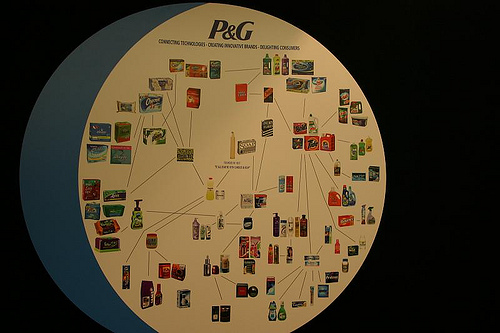
Proctor and Chance's Brands: Proctor and Gamble has various product lines.
You may too hear the product line breadth referred to equally the product width, product assortment width, and merchandize breadth.
Product Line Breadth and the Production Mix
The product mix of a visitor is generally defined as the complete ready of all products a business organisation offers to a market. The production mix (sometimes called "production array") is made up of both production lines and individual products.
A product line is a group of products within the production mix that are closely related, either considering they function in a similar way, are sold to the aforementioned client groups, are marketed through the aforementioned types of outlets or fall within given cost ranges.
An private product is a particular production inside a production line. It is a distinct unit inside the production line that is distinguishable by size, cost, appearance, or some other attribute. For instance, all the courses a academy offers constitute its product mix, courses in the marketing department found a product line, and the principles of marketing course is a product particular.
At present, there are iv dimensions associated with a company's product mix and the product line breadth is 1 of them. The other three are the length, the depth, and the consistency.
Going back in our P&Chiliad example we saw 5 dissimilar production lines: hair products, oral care, soaps and detergents, infant intendance, and personal intendance. This means that the production mix breadth is five.
Product Line Depth
Companies employ unlike strategies to expand their product line depth, which refers to the number of products in a specific production line.
Learning Objectives
Draw the dissimilar tactics for implementing full-line and express-line product strategies
Key Takeaways
Key Points
- Companies with total-line strategies attempt to heighten product line depth through carrying a loftier number of variations on a similar product in society to satisfy a broad range of different customer desires.
- Companies with limited-line strategies will carry a select few product variations with the highest impact, rather than carrying every conceivable variation of the product.
- Line-filling and line-pruning strategies tin take place, depending on whether there is a perceived void in the product line, or whether an existing product in the line becomes obsolete or unprofitable.
Fundamental Terms
- product line depth: Product line depth refers to the number of products in a company'south specific product line.
A product line can comprise one product or hundreds. The number of products in a product line refer to its production line depth, while the number of separate product lines owned by a visitor is the product line width (or breadth).

Vending Automobile: Soft drink companies tend to produce many variations of a similar products to fill out their product line.
There are ii bones strategies that bargain with whether the company volition attempt to carry every conceivable production needed and wanted by the consumer or whether they will carry selected items. The former is a total-line strategy while the latter is called a limited-line strategy.
Line-filling Strategies
Line-filling strategies occur when a void in the existing product line has non been filled or a new void has developed due to the activities of competitors or the request of consumers. Before considering such a strategy, several central questions should exist answered: Tin can the new product support itself? Will it cannibalize existing products? Volition existing outlets exist willing to stock it? Will competitors fill the gap if nosotros do not? What will happen if we do not deed?
Assuming that the company decides to fill out the product line further, there are several ways of implementing this conclusion. Iii are most common:
- Product proliferation: the introduction of new varieties of the initial product or products that are similar (due east.g. a ketchup manufacturer introduces a hickory-flavored sauce, a pizza-flavored barbecue sauce, and a special hot dog sauce)
- Make extension: stiff brand preference allows the company to innovate the related production under the brand umbrella (e.chiliad. Jell-O introduces pie filling and diet desserts under the Jell-O make proper name)
- Private branding: producing and distributing a related product nether the make of a benefactor or other producers (e.thou. Firestone producing a less expensive tire for Kmart)
In addition to the demand of consumers or pressures from competitors, there are other legitimate reasons to appoint in these tactics. Starting time, the additional products may accept a greater appeal and serve a greater customer base of operations than did the original product. 2nd, the additional product or brand can create excitement both for the manufacturer and distributor. 3rd, shelf space taken by the new product means it cannot be used by competitors. Finally, the danger of the original product becoming outmoded is hedged. Yet at that place is stil serious risk to consider: unless there are markets for proliferation that will expand the brand'southward share, the newer forms volition cannibalize the original product and depress profits.
Line-pruning Strategies
Line-pruning strategies involve the process of getting rid of products that no longer contribute to company profits. A uncomplicated fact of marketing is that sooner or later a production will decline in demand and require pruning. Timex has stopped selling domicile computers. Authentication has stopped selling talking cards. A great many of the components used in the latest motorcar have replaced far more expensive parts, due to the increased costs in other areas of the process, such every bit labor.
Using mod robotics technology has halved the manufacturing costs of several products. Through such implementation, Keebler Cookies moved from packaging their cookies totally by hand to 70% automation. Other possible ways a visitor might go more efficient are by replacing antiquated machinery, moving production closer to the point of sale, subcontracting out role of the manufacturing procedure, or hiring more productive employees.
Production Lines in Services
By productizing a service it tin be managed more similar a product and various product lines tin exist created.
Learning Objectives
State the criteria required to productize a service
Key Takeaways
Cardinal Points
- The service product manager identifies assisting service infinite, packages services in a productized grade, and delivers the same to the market place.
- Productizing a service involves the creation of necessary product documentation like executive materials, service production document, technical services certificate, and service scope.
- Like regular products, service products tin be ramped downwardly.
Fundamental Terms
- productize: To modify something to become suitable as a commercial product.
Introduction
Consider this scenario: you provide a service, allow's say image consulting. You've been in business for quite some time and have been charging an hourly rate. Business concern has been okay, only you constantly have to defend your rate to clients who benefit from your service but still complain that your charge per unit "seems to exist a bit high." Or perchance they are reluctant to even use your service because they don't know what they will exist getting for that toll.
Service providers oftentimes have to bargain with this problem. There is a solution, however, to productize the service.
How to Productize a Service
Productizing a service means making the service look more similar a product so that it is easier for customers to conceive, and thus buy. This involves:
- Giving it a defined scope;
- Putting it into a limited fourth dimension period;
- Attaching a definite price tag; and
- Giving information technology a distinctive name.
Going back to the prototype consulting business, instead of charging an hourly rate, you lot could productize your service by offering a "One-Day Makeover. " The product would consist of a:

Productizing: An prototype consultant tin can productize their service by offering a bundle which includes a wearing apparel and accessories shopping trip, beauty salon visit, and make-up application.
- Wardrobe assessment;
- Shopping trip;
- Beauty salon visit; and
- Make-upwardly awarding tips.
All of this would be offered for a fixed price. And in that location's no need to stop at that place. An entire product line (or lines) could be produced using the same technique.
If yous worked for a large corporation and developed a solution such equally this, you would be called a Service Product manager.
The Service Production Management
Service Production Management deals with managing a service product throughout its complete life cycle. This organizational function is as common in business concern-to-business as well equally business-to-consumer organizations.
A service product, different a hardware or software product, is intangible, and manifests itself as pure professional services or as a combination of services with necessary software and/or hardware.
The service product management practice ensures management of a profitable service in the market place.
The service product manager identifies a profitable service infinite, packages services in a productized form and delivers the same to the market. The function is a core service business direction function and is a mix of sales and marketing functions. The part interfaces with various organizational groups like strategy, planning, financial controls /management accounting, sales, marketing and communications.
Source: https://courses.lumenlearning.com/boundless-marketing/chapter/product-line-and-product-mix/
0 Response to "what does it cost to launch a new product, soap and to compete with p&g"
Post a Comment